THE ANATOMY OF A ROOM: The Entryway
Before a guest sits down, before they see the kitchen or takes in the view, they are already forming an opinion. The entryway is a room that most people refuse to treat as a room — and it shows.
After twenty-something years in interior design, I've come to believe the entry is the single most psychologically loaded space in any home. It manages transition. It holds identity. It does more emotional work per square foot than anywhere else under the roof. This Craftsman-era home — with its bold teal walls, white board-and-batten wainscoting, and deeply considered layering — is a masterclass in getting it right.
Let's take it apart, piece by piece
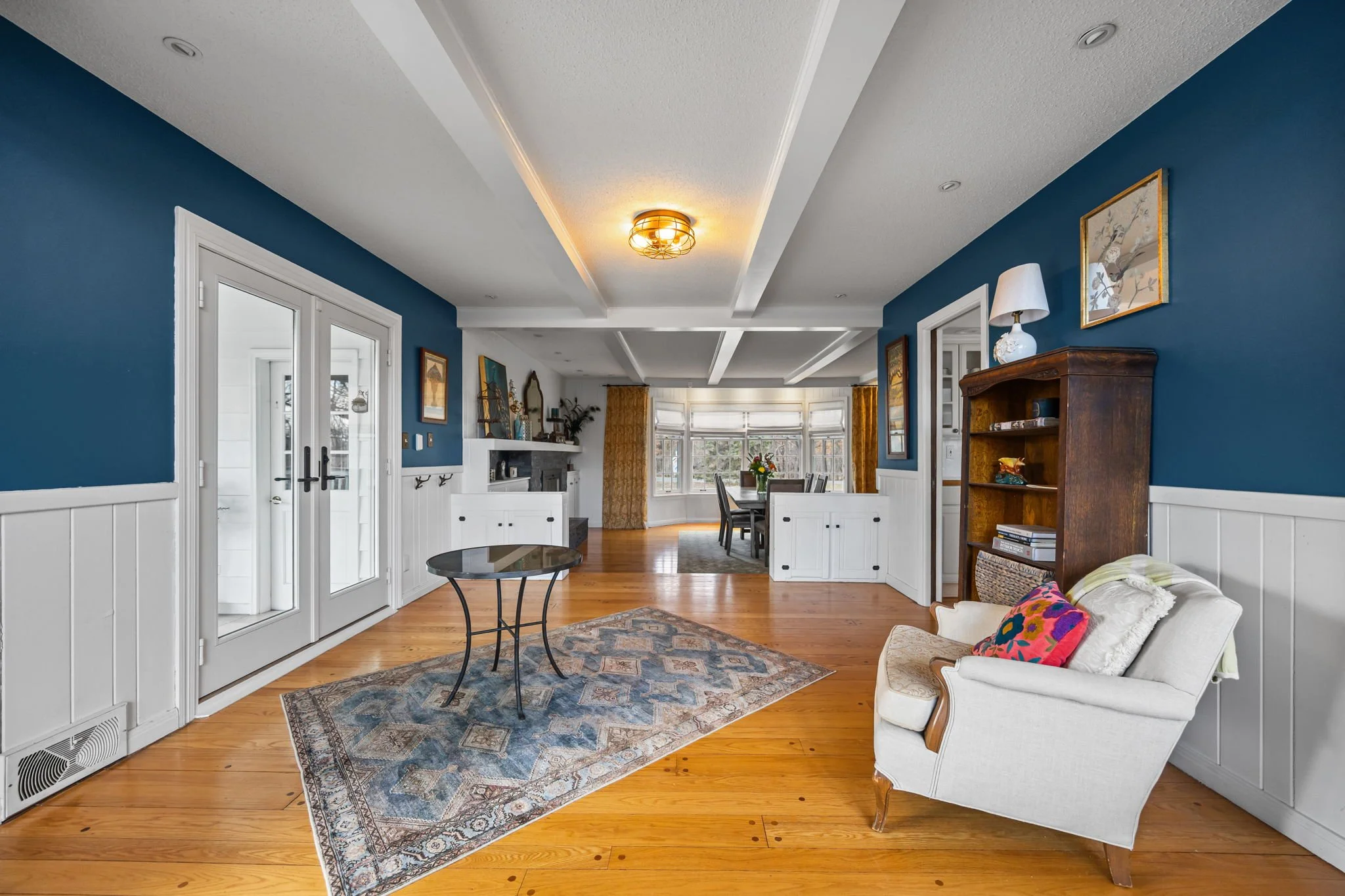
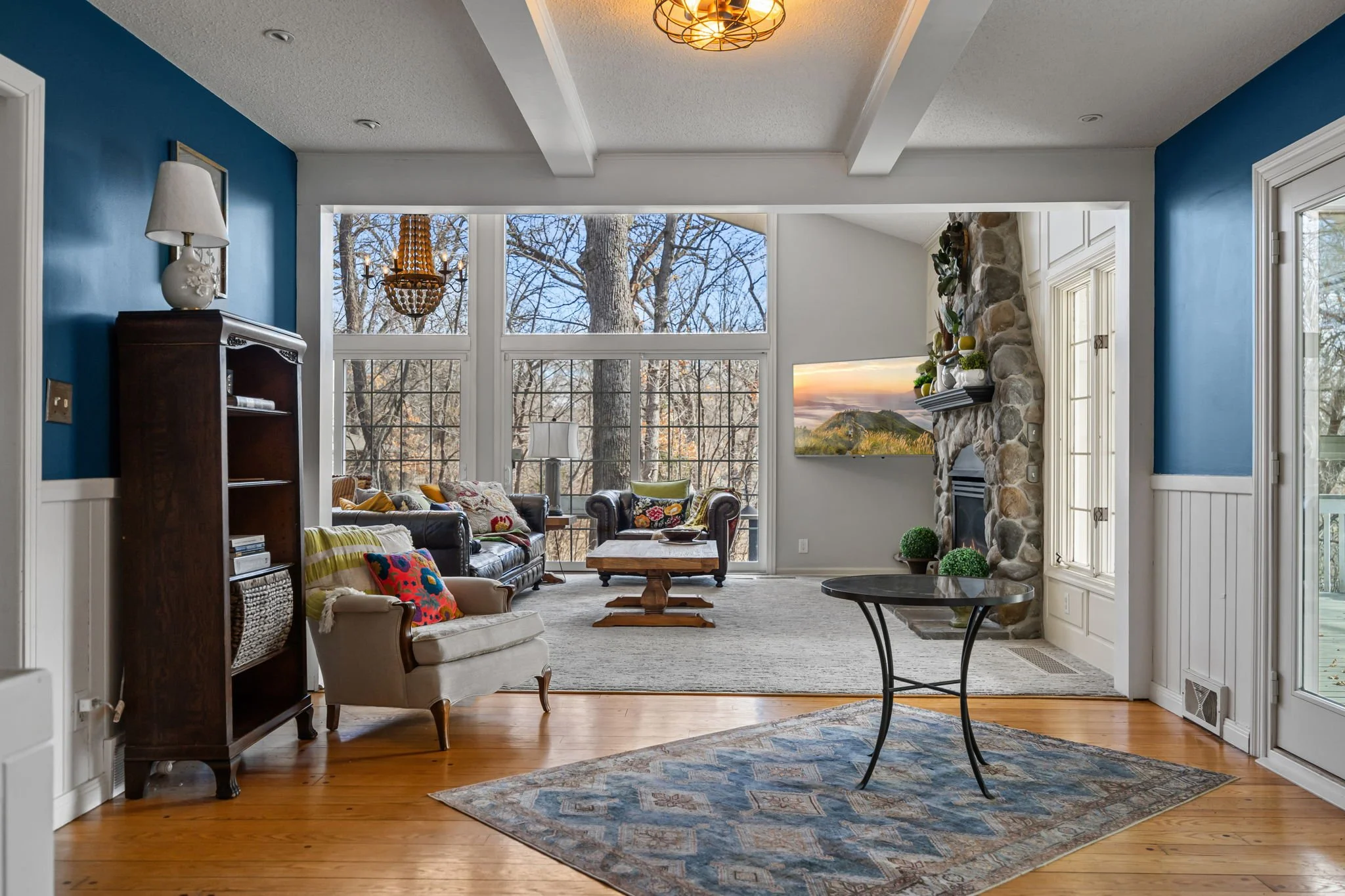
The full sweep of the entry — landing strip, sit & sip, and the sightline all the way through to the dining room.
|ELEMENT 01| THE LANDING STRIP - The circular table that anchors arrival
Every entry needs what I call a landing strip — a surface that catches the first moment of arrival. In this space, that job belongs to a slender, dark-steel circular table sitting almost casually on the rug. It is not precious. It is not overstuffed with a lamp and a stack of coffee-table books trying too hard. It simply exists as a place to pause.
The circular form is deliberate. Circles carry no hierarchy — no corner that faces away from anyone. They welcome from every angle, which makes them the most socially generous shape in furniture. Paired here with iron hairpin-style legs, this table introduces an industrial counterpoint to the traditional wainscoting without a single word of apology.
“A landing strip doesn't need to hold much. It needs to hold the moment: the keys, the breath, the transition from outside to in."
Scale matters enormously. Too large and it becomes an obstacle; too small and it reads as an afterthought. This one hits the sweet spot: substantial enough to anchor the rug beneath it, restrained enough to let you read the full length of the room in a single glance.
|ELEMENT 02| THE SIT SIP - The chair arm that turns a threshold into a room
Here is the move that separates an entry from an entryway: seating. The moment you place a chair in a threshold space, you are making a declaration — this is a room, not a corridor. The cream upholstered wingback anchored beside the antique bookcase does exactly that.
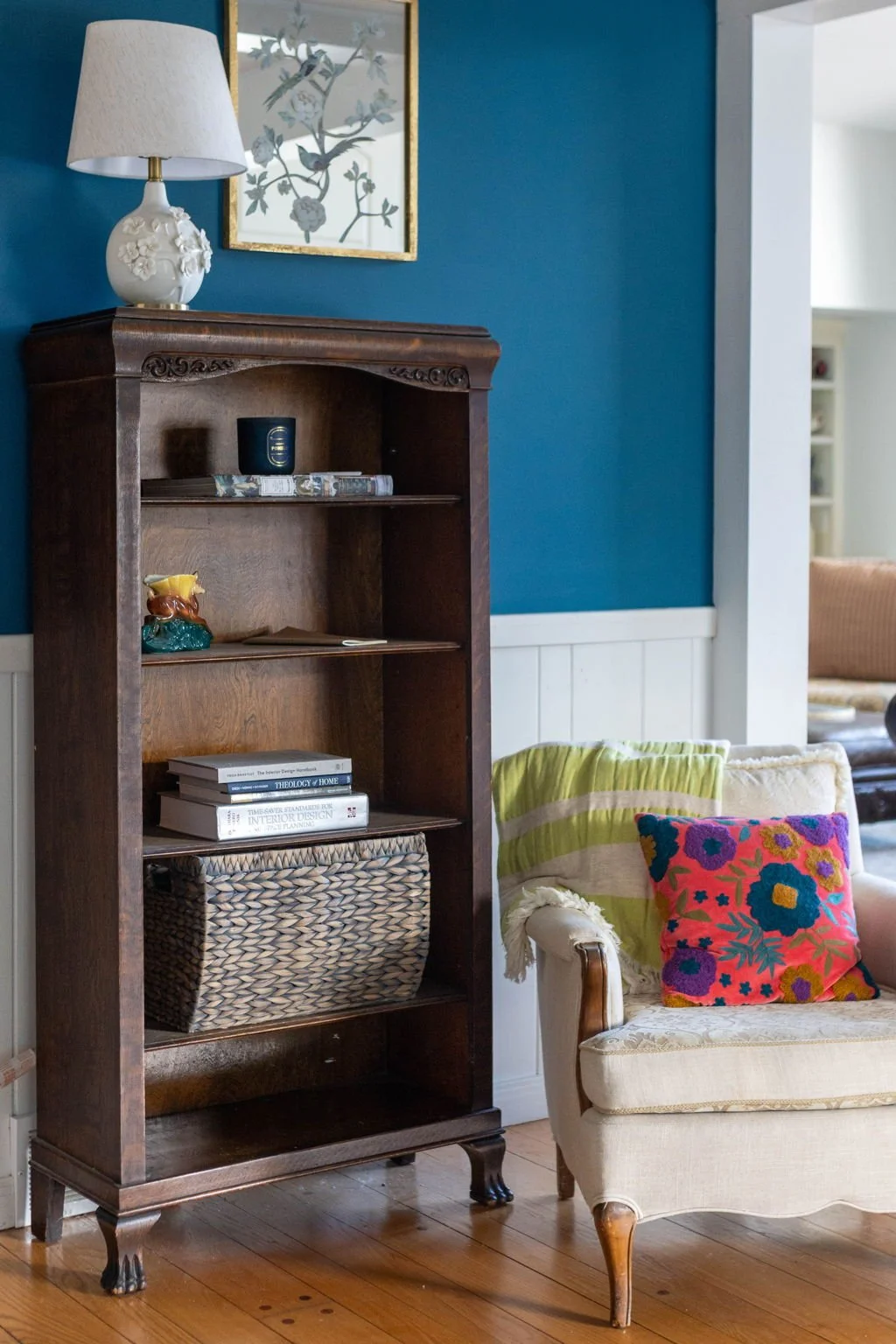
left: The bookcase and wingback pairing — antique in spirit, warm in tone. Note how the embroidered pillow bridges every color in the room.
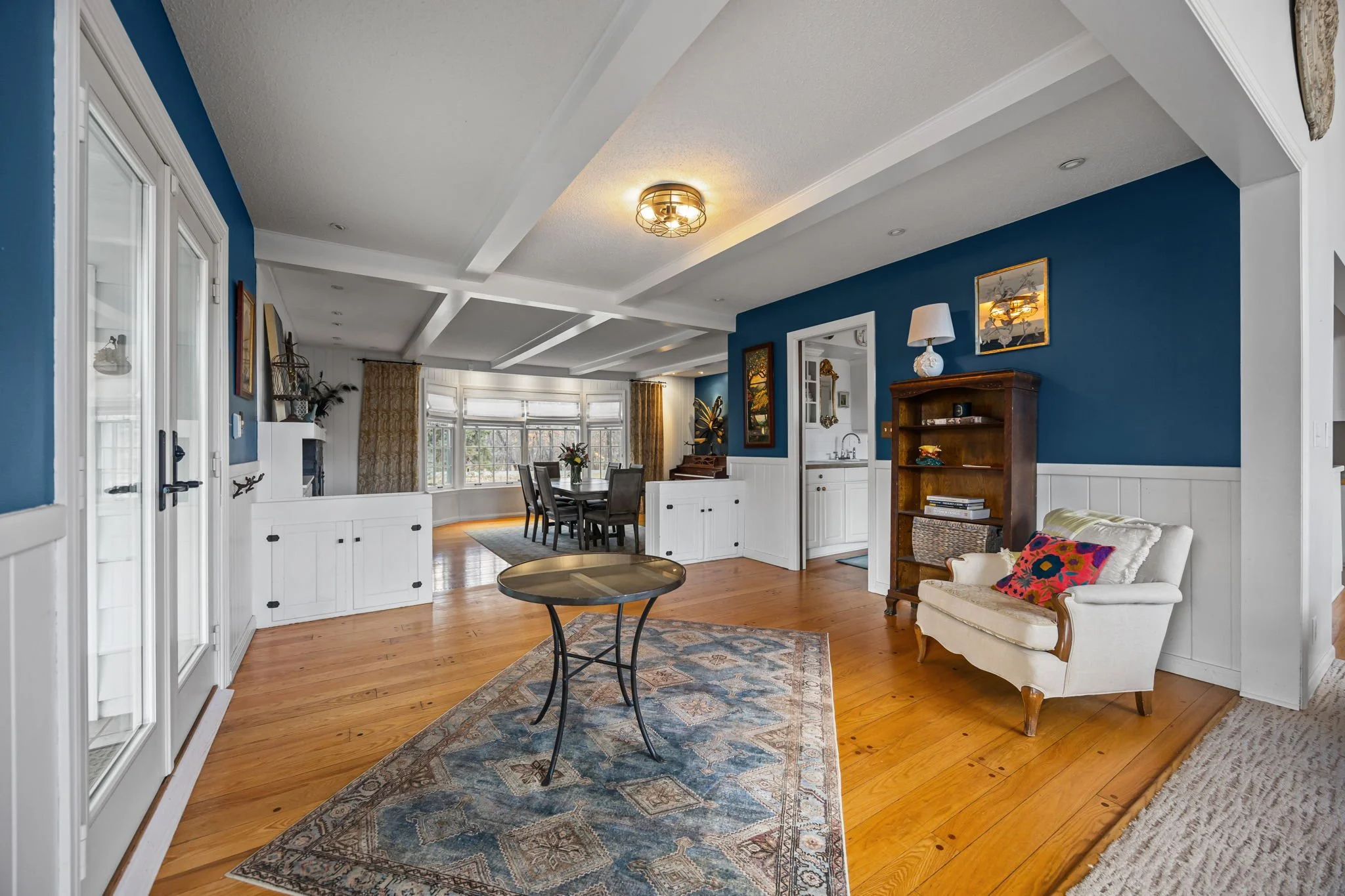
right: The second view reveals how generously the space flows from entry into the living room beyond.
The wingback's carved wooden legs echo the bookcase beside it — both antique in spirit, both grounded in warm honey tones that contrast beautifully against the deep blue walls. The embroidered floral pillow in saturated coral, teal, and gold does the heavy lifting: it bridges the blue of the walls, the rust in the rug, and the warmth of the wood floors in a single gesture.
Designer's Note: When placing a chair in an entry, orient it slightly inward, angled toward the room's interior, not squared against the wall. The angle signals permission to linger and makes the space feel at least twenty percent larger than it actually is.
|ELEMENT 03| REFLECTION - Light, depth, and the art of the well-placed mirror
An entryway without a reflective surface is a room that refuses to breathe. Mirrors in an entry serve a dual function that most people reduce to one: yes, you check yourself before leaving. But more importantly, the mirror doubles the light, amplifies the sense of depth, and creates a visual conversation between spaces.
“A mirror in an entry isn't vanity — it's architecture. It adds a room that doesn't exist."
The art throughout this entry also reflects back something deeper: the Japanese botanical print above the bookcase, the framed peacock painting in deep teal above the built-in cabinet. These pieces mirror the homeowner's interior life back to anyone who enters. Rooms with art say something. This one says a great deal.
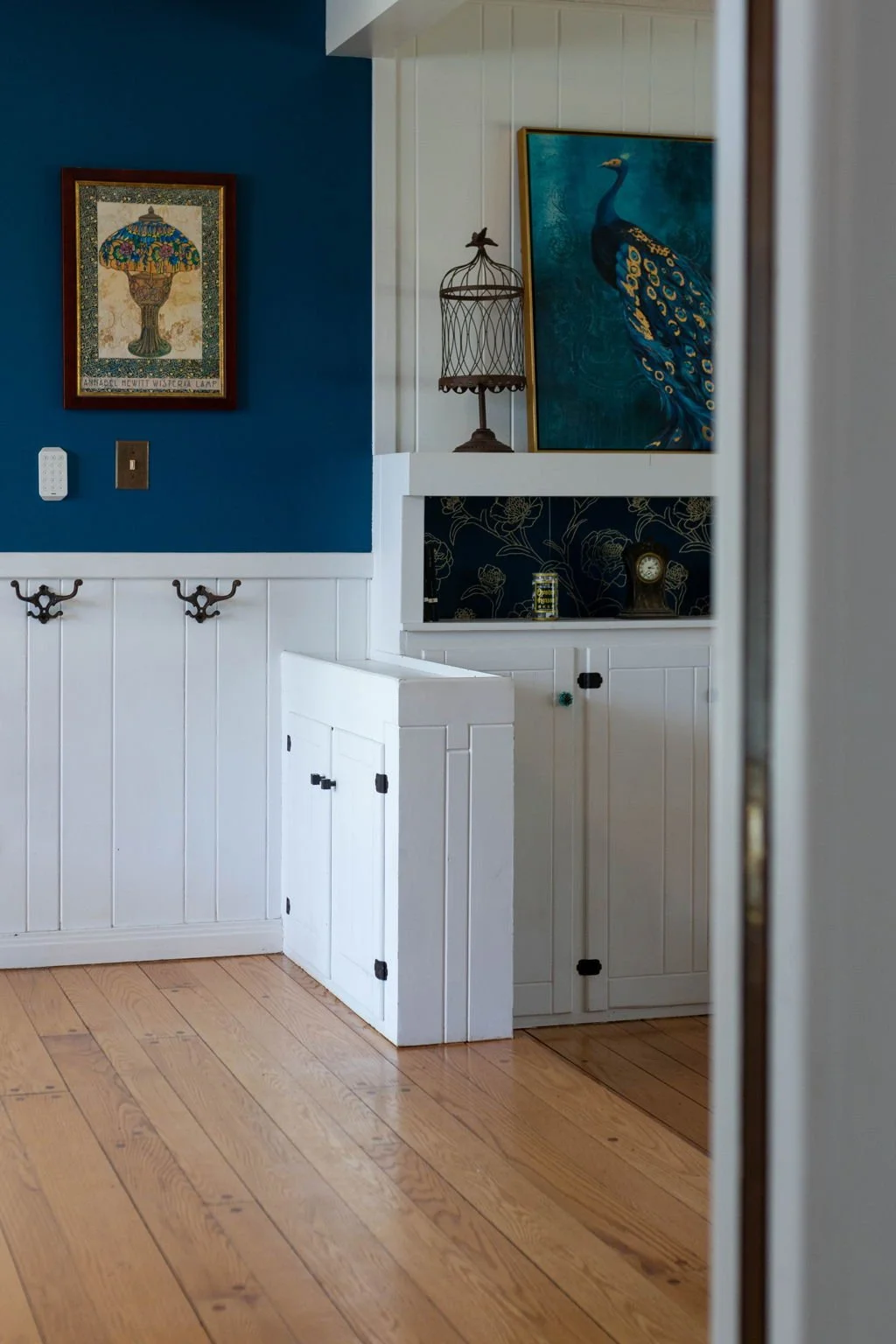
The built-in cabinet vignette, teal peacock painting, antique birdcage, dark floral wallpaper panel. A gallery wall compressed into a single architectural moment.
|ELEMENT 04| LIGHTING - The brass cage fixture that sets the entire tone
Lighting is where most entry renovations go quietly wrong. The choice tends to be either a chandelier that announces itself too loudly, or a recessed can that whispers nothing at all. This entry threads the needle with a brass cage flush-mount that hits every mark: period-appropriate to the Craftsman bones of the house, warm amber glow that flatters the teal walls rather than bleaching them, and interesting enough to notice without demanding attention.
The coffered ceiling, all white-painted beams against a lightly textured field, does the architectural work of grounding the fixture, framing it the way a mat frames a print. The result is a ceiling that feels composed rather than just functional.
From the great room looking back, the brass cage flush-mount anchors the coffered ceiling, while the bookcase lamp adds the essential second layer of warmth at eye level.
Notice the table lamp perched on the antique bookcase: a white ceramic base with sculptural floral relief, topped with a clean white shade. This secondary light source is crucial. An entry lit only from above creates flat, institutional light. Add a secondary source at eye level and suddenly the room has dimension - warmth in some corners, shadow in others.
Designer's Note: Always layer your entry lighting with at minimum two sources: an overhead anchor and a table or wall lamp. Even light is institutional. Uneven light is residential. The goal is pools of warmth, not a room lit like a showroom floor.
|ELEMENT 05| THE DROP ZONE - Hooks that work as hard as they look
Function dressed as poetry — that is the standard I hold for any good drop zone. And these hooks deliver it completely.
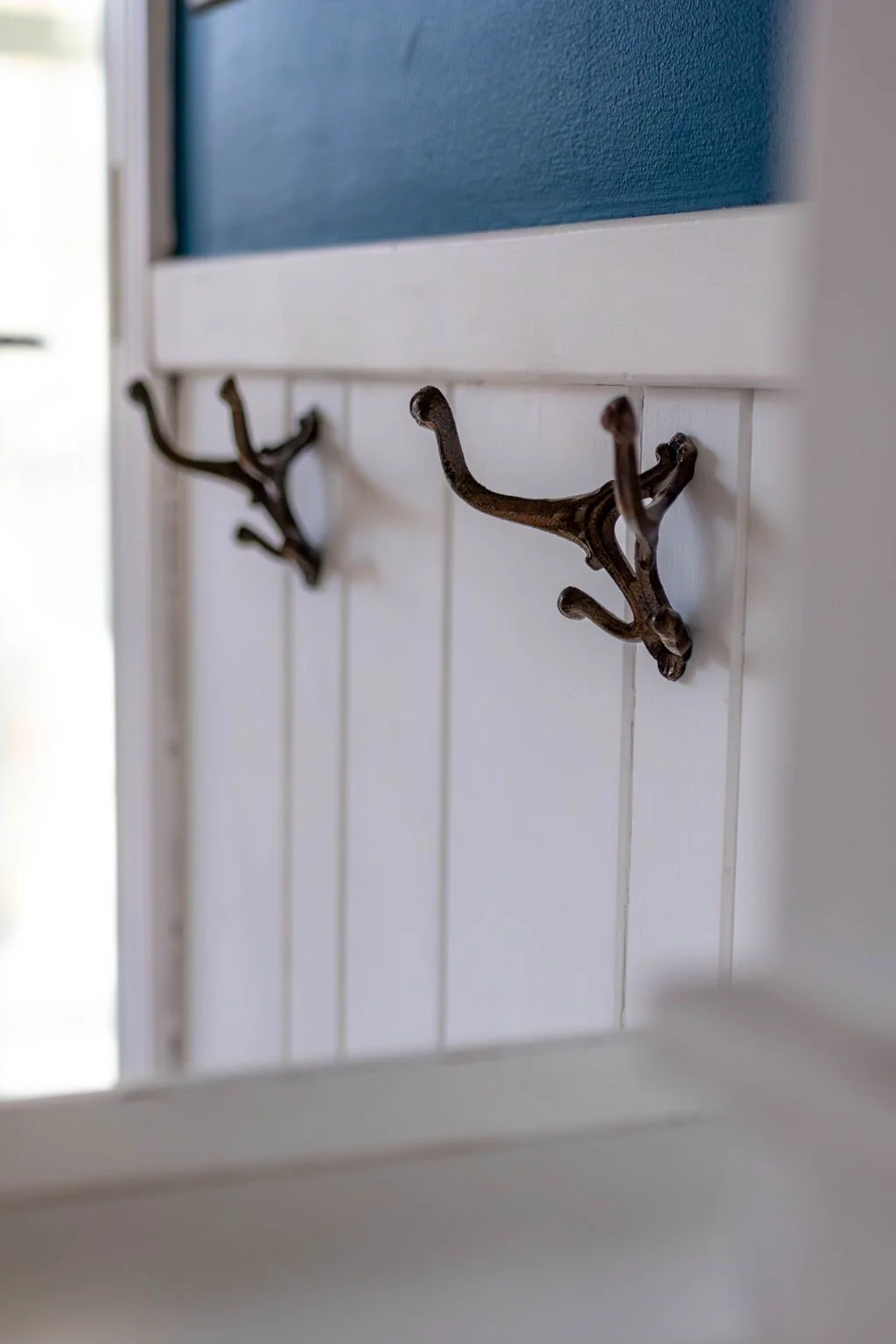
Cast-iron twig hooks on board-and-batten. Organic form against strict geometry — the Craftsman tradition in a single detail.
Cast-iron twig-and-branch hooks, dark and aged, mounted into the white board-and-batten wainscoting. They photograph beautifully, but more importantly they are doing real work: holding coats, bags, and whatever a Minnesota winter demands at the door.
The choice of an organic, nature-inspired form is meaningful in context. Against the strict geometry of the vertical planks behind them, these naturalistic hooks introduce the feeling of the outdoors brought inside, honoring the Craftsman tradition's deep reverence for handcraft and nature.
The white wainscoting itself deserves a full moment of recognition. Board-and-batten below the chair rail is one of the most durable design choices in American residential architecture — forgiving of scuffs, classical in reference, and endlessly adaptable. Kept crisply white here, it provides the neutral ground that lets the navy walls above read as bold rather than overwhelming.
“A hook is the most democratic object in a home. It asks nothing of the person who uses it, except that they stay a while."
|ELEMENT 06| TEXTURE - The rug that holds everything together
If the teal walls are the entry's drama and the coffered ceiling is its architecture, the Persian-style rug is its soul. A room without a rug on hardwood floors echoes — acoustically and emotionally. The rug absorbs sound, defines zones, and introduces the warmth that hard surfaces cannot manufacture on their own.
This particular rug does something especially intelligent: it pulls from both the cool blue of the walls and the warm honey of the pine floors in its color palette. The dusty blues, burnt siennas, and faded creams in its medallion pattern hold the entire color story of the entry in a single textile. When someone tells me they can't find a rug that "goes with everything," I point to choices like this — antique-washed, slightly faded, complex in pattern — because they were made to go with everything.
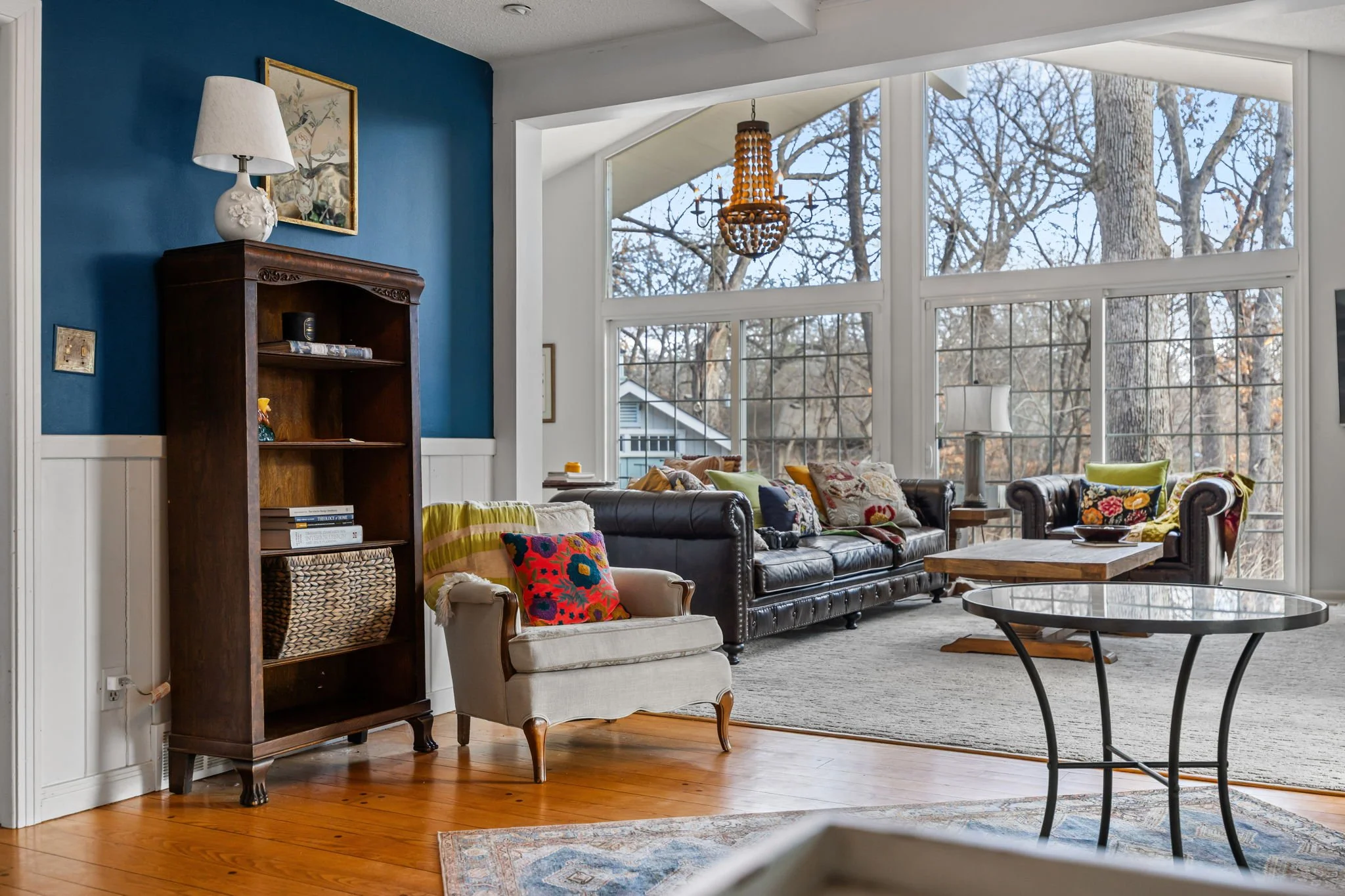
Scale, again, is everything. The rug extends beneath the circular table and gestures toward the wingback chair — large enough to unify the furniture arrangement, not so large that it swallows the warm pine border around it. That visible perimeter of hardwood floor is part of the composition, not an afterthought.
Designer's Note: In a through-entry: a space that connects rooms rather than terminating at a wall, resist centering the rug on the room. Center it on the furniture grouping instead. The rug's job is to hold the seating arrangement, not to measure the floor.
The entryway is never just an entry.
It is the first sentence of the story a home tells about the people who live in it. When the six elements work together — landing strip, seating, reflection, lighting, drop zone, texture — the space stops being a corridor and becomes a room that knows exactly what it is.
This one does.